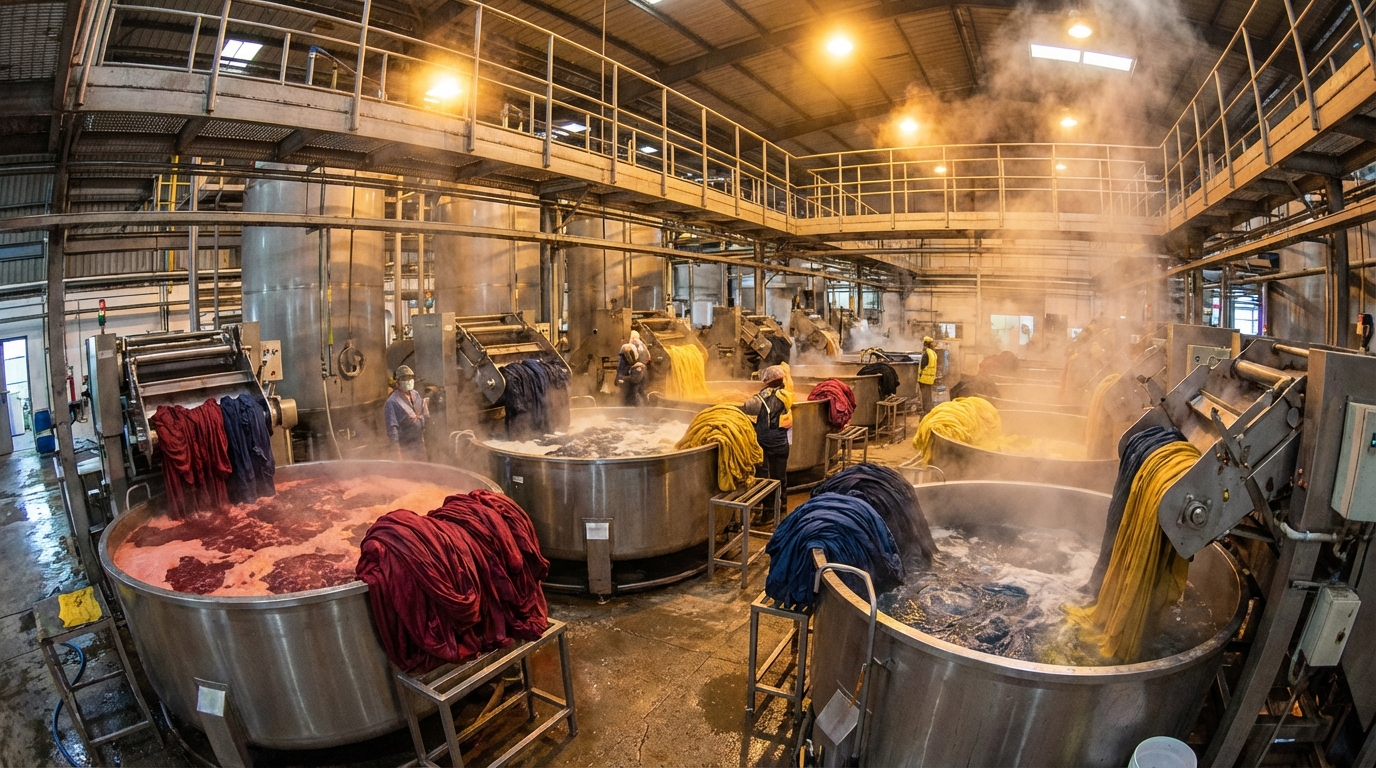
When teams talk about cotton knit dyeing, the default discussion still tends to be conventional exhaust dyeing. But for programs that care about energy reduction, continuous processing rhythm, and better unit economics, reactive cold pad batch dyeing deserves serious attention. It is not the right route for every order, but in the right conditions it can improve cost, environmental load, and production efficiency together.
Cold pad batch works best when the project conditions are clear
The basic idea is simple. The fabric is padded with dye liquor and alkali, then batched for fixation instead of staying in a long high-temperature exhaust process. That is why the method naturally supports lower energy use and a more continuous workflow.
It usually fits best when the order has:
- Stable shades or a controlled color range
- Medium to large volume
- Open-width processing logic
- Pressure to improve efficiency and reduce utility cost
If the program has constant shade changes, highly fragmented lots, or very demanding deep-shade repeatability, cold pad batch may be harder to control than the headline benefit suggests.
The real advantage is process rhythm, not just lower temperature
Cold pad batch is often described as a low-temperature dyeing method, but that only captures part of the story. Its bigger operational value comes from separating liquor application from fixation, which makes continuous production logic more realistic.
| Dimension | Cold pad batch | Conventional exhaust dyeing |
|---|---|---|
| Energy use | Lower | Higher |
| Water use | Lower | Higher |
| Production rhythm | Better suited to continuous flow | More dependent on batch cycles |
| Small-lot flexibility | Weaker | Stronger |
| Dependence on uniform pick-up | Very high | Lower |
So the method should not be treated as “simpler.” It is more accurate to say it is more system-dependent.
With cotton knits, the biggest risks are uniformity and dimensional control
Cotton knits are softer and more distortion-sensitive than many woven constructions. That means uneven pick-up, weak batching control, or incomplete washing can show up more obviously in the final result.
The main checkpoints are:
- Clean and consistent pretreatment
- Stable wet pick-up across the width
- Controlled batching time and ambient conditions
- Sufficient washing and soaping to clear unfixed dye and alkali
- Finishing that protects both hand feel and dimensional stability
For knit programs, spirality, shrinkage, and edge behavior deserve extra attention because the dyeing route cannot be judged independently from the fabric structure.
The decision should be based on total project economics, not one process headline
The attraction of cold pad batch usually comes from total cost logic rather than one isolated process metric. Source material points to clear energy and cost advantages, but only when process stability is already under control.
The practical review should include:
- Whether the color plan supports continuous processing
- Whether frequent formula changes would erase the efficiency gain
- Whether the mill already has mature open-width cold pad batch capability
- How sensitive the customer is to shade variation, hand feel, and post-wash behavior
If a team sees only the sustainability angle and ignores control difficulty, the savings can disappear quickly in rework or quality claims.
Cold pad batch is a chain capability, not a single machine capability
Some mills present cold pad batch as a machine feature, but bulk success depends on the whole chain:
- Pretreatment quality
- Padding consistency
- Batching control
- Washing and soaping
- Drying, setting, and finishing
Any weak point in that chain can affect shade, touch, or garment behavior. That is especially true for stretch knits and close-to-skin programs where post-wash performance matters more than lab appearance alone.
When should buyers put this route on the table first
Cold pad batch is worth early consideration when:
- The substrate is cotton or cotton-rich knit
- The shade plan is concentrated enough for continuity
- The volume can justify setup and control effort
- The buyer cares about energy, water, and total processing cost
And if your team is also reviewing wash stability and colorfastness, our piece on dyeing quality control and colorfastness is a good companion because process efficiency only matters when bulk quality remains dependable.