Textile Factory Automation ROI in Apparel Manufacturing: What It Means for Fabric Lead Times and Cost
Automation in a knit fabric factory does not automatically shorten your lead time or lower your price. Textile factory automation ROI in apparel manufacturing is real only when it is applied to the right production steps — handling, cutting, stacking, and visual inspection first — and when the mill runs those steps at high utilization. For a buyer, the practical question is not whether a supplier is “automated,” but which specific step is automated, what it changed, and whether your order profile lets you capture the benefit.
This guide breaks down where automation is real in knit fabric production, how it moves sampling and bulk lead times, where it touches cost per kilogram, and how to verify a supplier’s claims before you build them into your sourcing plan.
What ‘Automation’ Actually Means Inside a Knit Fabric Factory
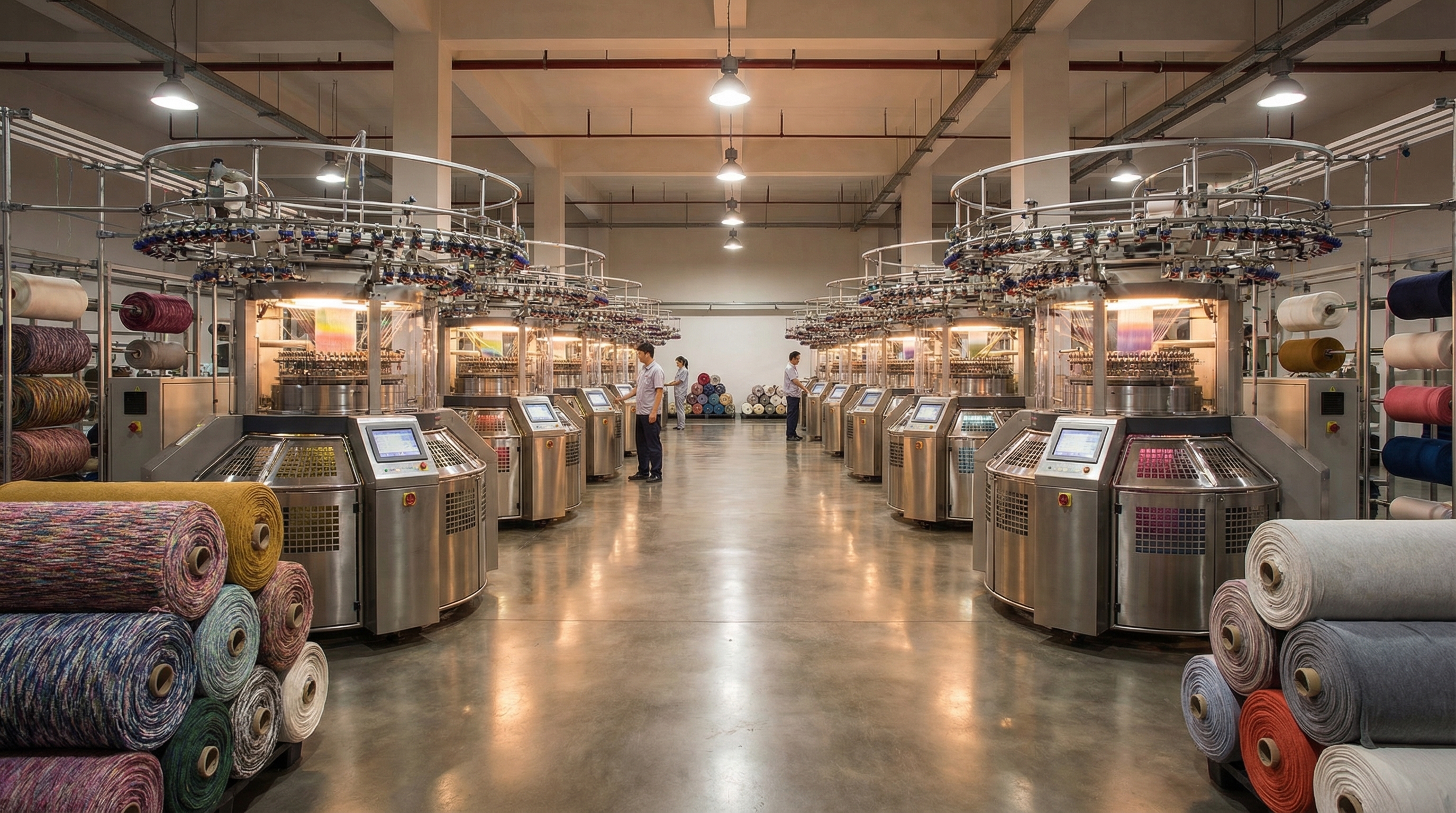
Automation in a knit fabric mill is not one system but a stack of separate investments, and the layer a supplier is describing determines whether you should expect a lead-time effect or only a quality-consistency effect. Machine-level automation — electronic yarn feeders, tension control, stop-motion sensors — is already standard on modern circular knitting equipment, including the 200+ circular knitting machines in a well-equipped plant. Process-level automation, which coordinates scheduling, material movement, and quality data across knitting, dyeing, and finishing, is where most remaining gains sit.
The highest-ROI starting points are repetitive, standardized tasks — handling, cutting, stacking, and visual inspection — rather than full sewing automation. That pattern holds because these tasks are predictable, easy to measure, and do not require the mill to solve the hardest technical problem first.
Knitting, dyeing, and finishing are three separate automation problems. A mill can truthfully claim “automated knitting” while still running manual material handling between departments. When a supplier says “automated,” ask which layer is meant: machine-level or process-level. Machine-level automation mainly buys consistency; process-level automation is what can move your quoted lead time.
Which Production Steps Make Sense to Automate First
Handling and material movement come first, because they carry low technical risk, reduce labor immediately, and cut handling defects such as snags and contamination. Cutting and stacking follow, since they are highly repeatable and well-suited to robotic or semi-automated cells. Visual inspection is the third priority: camera- and AI-based systems catch defects faster and more consistently than manual inspection, and they generate data that feeds a documented QC system.
Dyeing and finishing are a different category. Automation here is about dosing accuracy, recipe control, and repeatability rather than robotics. Automated dye dosing reduces the variance between lots, which reduces reprocessing. Finishing automation — tension control, temperature control, and inline measurement — improves consistency of hand feel and width.
Sewing and complex assembly remain the hardest to automate economically. Buyers should not expect sewing automation to drive fabric lead-time gains in the near term. The table below summarizes feasibility and typical impact by stage.
| Production stage | Automation feasibility | Typical lead-time impact | Typical cost impact |
|---|---|---|---|
| Yarn handling & feeding | High — standard on modern circular knitting | Small direct time saving; fewer yarn-related stoppages | Lower labor per kg; less yarn waste |
| Knitting | High at machine level; medium at process level | Fewer unplanned stops; more stable daily output | Lower defect rate; better machine utilization |
| Dyeing | Medium — dosing and recipe control, not robotics | Shorter lab dip iteration; fewer re-dye cycles | Lower chemical and energy use per kg |
| Finishing | Medium — tension, temperature, inline measurement | Fewer reworks; less waiting between stages | Lower second-quality volume |
| Inspection | High — camera and AI systems | Cuts queue time between finishing and packing | Lower inspection labor; earlier defect detection |
| Packing | Medium — semi-automated folding and bagging | Small time saving at end of line | Lower labor per kg |
| Sewing / assembly | Low — still hard to automate economically | Not a near-term lead-time lever for fabric | Not a near-term cost lever for fabric |
How Automation Changes Fabric Lead Times
Sampling lead time is compressed mainly by faster lab dip, faster dye recipe iteration, and quicker inspection turnaround. When dye dosing is automated and recipe data is captured digitally, the loop between “submit lab dip” and “approve shade” shortens because fewer iterations are needed. Inspection automation then shortens the final check before a sample is released.
Bulk production lead time is compressed by fewer reworks, less waiting between stages, and tighter scheduling across knitting, dyeing, and finishing. The largest single gain usually comes from removing queue time — the invisible waiting that sits between departments. Automated inspection reduces the queue between finishing and packing, which is often where finished fabric sits longest.
Integrated knitting-dyeing-finishing operations remove inter-plant transport time that fragmented supply chains cannot avoid. When knitting, dyeing, and finishing sit in one facility, fabric does not wait for a truck. As a reference point, yxxfabric’s own quoted ranges for a mill with integrated operations and this level of automation are sampling at 15–30 days and bulk production at 35–45 days. Treat those as our quoted benchmarks, not an industry-wide statistic, and compare them against what a supplier claims automation has changed.
For a deeper look at how sampling timelines are built, see our breakdown of the fabric sampling lead time process.
How Automation Changes Fabric Cost
Labor cost per kilogram falls where handling, stacking, and inspection are automated. These are the stages with the most repetitive manual work, so they are also where headcount reduction is most direct.
Rework and second-quality cost falls when inspection and dye dosing are more consistent. A camera-based inspection system catches defects earlier in the process, which means less value is added to fabric that will ultimately be downgraded. Automated dye dosing reduces the number of lots that need reprocessing.
Energy and chemical cost falls where dyeing automation improves recipe accuracy. Fewer re-dye cycles mean less water, less steam, and fewer chemicals per kilogram of finished fabric.
Automation does not automatically lower the price a buyer pays. Mills may absorb savings, reinvest them in capacity, or pass them through depending on capacity utilization and order mix. A mill running near full capacity has less incentive to pass savings through than one competing for volume. Ask which specific cost line the automation targets — labor, rework, energy, or chemicals — rather than asking whether the mill is “automated.” For a full cost structure view, see our integrated fabric sourcing cost breakdown.
ROI Reality Check for Mills — and What It Means for Buyers
Automation ROI depends on utilization. A mill running near capacity recovers investment faster than one with idle machines, because the same capital cost is spread over more output. This is why automation and order stability are linked: automated lines need predictable volume to pay back.
As an industry estimate rather than a verified figure, payback periods reported for textile automation tend to be shorter for high-utilization inspection and dye-dosing projects and longer for robotics-heavy handling cells, because inspection and dosing are lower-capex and directly reduce rework. Treat any specific payback number a supplier quotes as a claim to verify against their utilization and order mix, not as a guarantee.
High-mix, low-volume orders are harder to automate profitably than stable, repeat programs. Frequent changeovers reduce the effective benefit of automated handling and inspection, because the system spends more time being reconfigured.
MOQ and order stability therefore directly affect how much automation benefit a buyer can capture. A buyer with a repeating program gives the mill the utilization it needs to justify automation, and that buyer is better positioned to negotiate lead-time and cost improvements tied to it. A mill’s MOQ is a signal of the order stability its automated lines need to run efficiently. For example, an MOQ of 500 kg per color and 2,000 kg per order reflects the minimum batch size at which automated dyeing and inspection remain economic.
If your program is small or highly seasonal, expect less automation benefit and plan lead times accordingly. If your program is stable and repeating, ask the mill directly how automation has changed their quoted lead times for orders like yours.
ROI at a glance
| Stage | Capex band | Payback driver | Buyer-negotiable lever |
|---|---|---|---|
| Inspection (camera/AI) | Lower | Rework reduction and inspection labor | Defect-rate guarantees; AQL-linked QC reporting |
| Dye dosing & recipe control | Lower–medium | Fewer re-dye cycles; chemical and energy savings | Lab dip iteration count; shade approval turnaround |
| Handling & stacking | Medium | Labor per kg at high utilization | Order stability commitments; batch size |
| Finishing (tension, temperature, inline measurement) | Medium | Fewer reworks; less second-quality volume | Width and hand-feel consistency specs |
| Sewing / assembly | High | Not yet economic at scale | Not a near-term lever for fabric buyers |
How to Verify a Supplier’s Automation Claims
Ask which specific production step is automated and what the before/after lead time or defect rate was. A supplier who cannot name the step and the measured change is describing marketing, not automation.
Ask for a factory walkthrough or video of the actual automated line, not a stock image. Seeing the line in operation, with your own eyes or on a live call, is the fastest way to separate real investment from a brochure claim.
Ask how automation interacts with their QC process. For example, whether inspection automation feeds into a documented AQL system. A mill with 5-step QC from yarn inspection to final fabric inspection at AQL 2.5 has a traceable process that automation should strengthen, not bypass.
Ask whether sampling and bulk lead times are quoted separately and whether automation has changed either. Cross-check claims against certifications such as OEKO-TEX Standard 100 and ISO 9001, which require traceable process control. A supplier that holds both certifications and can show you the automated line is a supplier whose claims you can carry into your own planning.
References
- Which Textile Production Steps Make Sense to Automate First
- Fabric Sampling Lead Time Process
- Integrated Fabric Sourcing Cost Breakdown
- China Supply Chain Efficiency Moat After Textile Shift
- yxxfabric.com If you are evaluating knit fabric suppliers and want to test these lead-time and cost assumptions against a real production line, request samples or a quote from our Guangzhou facility. We will quote sampling and bulk lead times separately so you can compare them directly with your current supply base.