How to Source Knit Fabric for a New Clothing Brand
If you are learning how to source knit fabric for a new clothing brand, the process follows six ordered steps: define a one-page fabric spec, verify factory-direct suppliers, run sampling (15–30 days), plan MOQ around 500 kg per color and 2,000 kg per order, produce bulk (35–45 days) under a 5-step QC protocol at AQL 2.5, and build a calendar that sequences every approval gate. Expect the sampling and bulk windows to add up from spec freeze to bulk fabric in hand, plus shipping and garment production time.
Step 1: Define Your Knit Fabric Spec Before You Contact Anyone
Write a one-page spec before you email a single supplier — it is the document that makes quotes comparable and prevents months of re-sampling. Most first-time founders contact five factories with a vague idea (“a heavy cotton jersey”) and receive five quotes that cannot be compared. A written spec fixes that.
Start from the garment end-use, because it drives every technical choice. A t-shirt needs a different fabric from a sweatshirt or a rib trim. Lock the end-use first, then translate it into five spec lines:
- Composition — e.g. 100% combed cotton, 60/40 cotton-poly, or 85/15 cotton-spandex.
- Weight in GSM — the factory’s range runs 180–360 GSM; a standard jersey sits at the lighter end, fleece and heavy terry at the top.
- Stretch and recovery — whether you need mechanical stretch (rib structures) or elastane (cotton-spandex).
- Color — a Pantone reference, not a verbal description.
- Finish — brushed, calendered, or a special treatment, since finishing changes hand-feel and cost. Then mark each line as fixed or negotiable. Composition and weight are usually fixed; exact GSM within a small band and finishing details are often negotiable. This distinction is what you send to every supplier, and it is also what you defend internally when a factory proposes a substitute. For a deeper walkthrough of how a spec becomes a development project, see our guide to the custom knit fabric development process.
Step 2: Shortlist and Verify Knit Fabric Suppliers
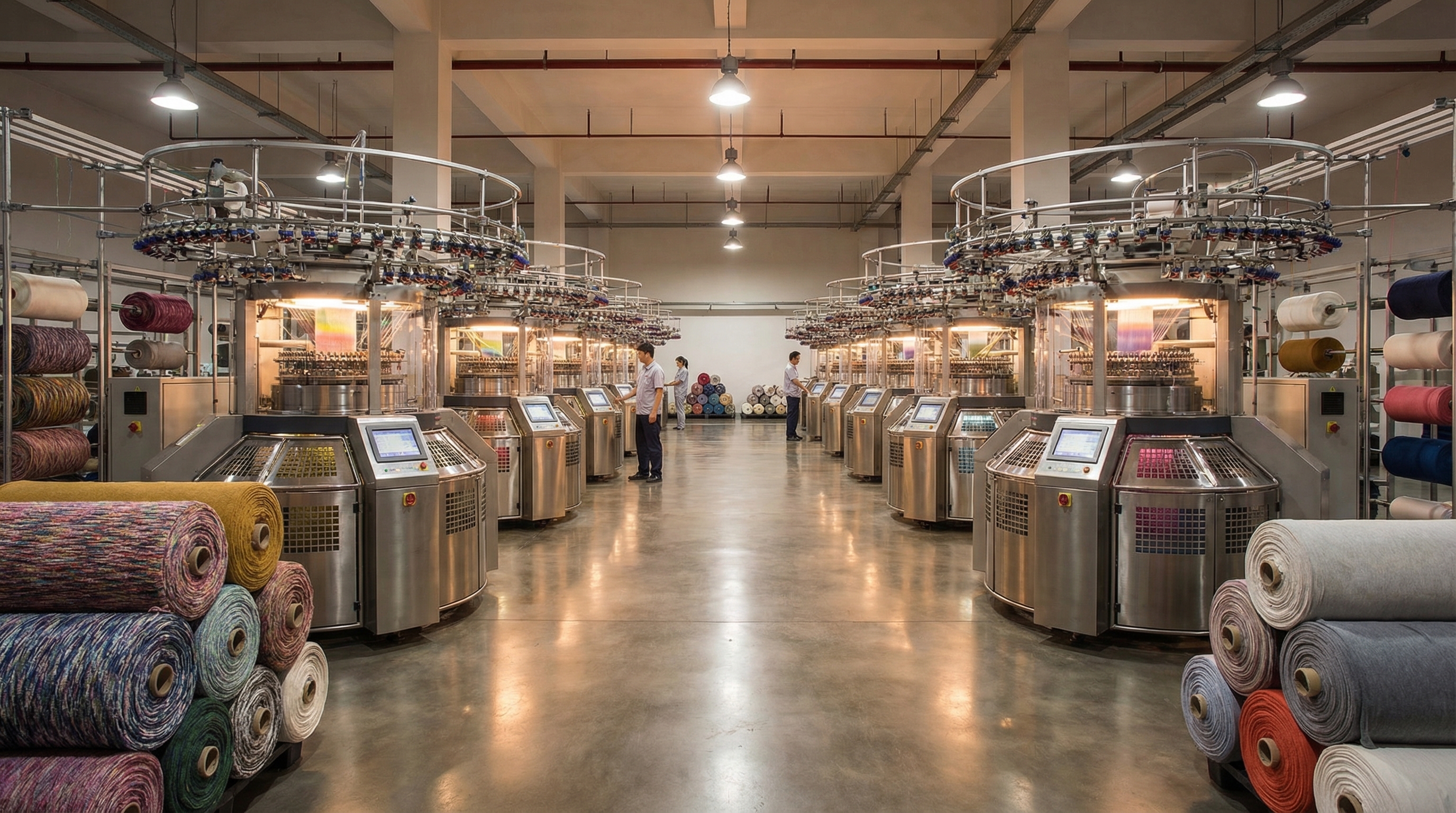
Verify that your supplier is factory-direct with in-house knitting, dyeing, and finishing before you invest time in development — a trader adds a layer of risk you cannot inspect. The single most useful question in supplier vetting is: “Which steps do you perform in your own plants?” A manufacturer that knits, dyes, and finishes under one roof controls lead time and quality at each stage; a broker controls neither.
Four checks belong on every shortlist:
- Factory integration. Ask for the plant list and what happens at each site. An integrated operation with 30,000 m² of factory space and 200+ circular knitting machines is a different risk profile from a trading office.
- Certifications relevant to your market. OEKO-TEX Standard 100 and ISO 9001 are the baseline documents European and North American buyers expect to see. Ask for current certificates, not photos of old ones.
- Experience level. Fifteen years in knit manufacturing means the factory has seen enough development projects to flag problems early. Ask how long they have operated and what share of their output is export.
- Sample cards and swatches. Request swatches before committing to development. How a supplier handles a swatch request — speed, labeling, honesty about what is in stock — predicts how they will handle a bulk order. Capacity is the final filter. A mill producing 1,000 tons per month can absorb a new brand’s first order without deprioritizing it. For a broader checklist on evaluating Chinese mills, read our fabric sourcing guide for clothing brands.
Step 3: Sampling — Lab Dips and Sample Yardage (15–30 Days)
Sampling takes 15–30 days from approved spec to sample yardage in hand, and color approval is a separate gate from fabric approval. New brands routinely underestimate this window because they treat sampling as one event. It is at least two: lab dip approval, then sample yardage.
Lab dips come first. The factory dyees small color swatches to your Pantone reference and sends them for approval. Approve color before sample yardage is knit — if you skip this, you risk knitting meters of fabric in a shade you will reject. Review lab dips under the lighting conditions your customer will see the garment in, and sign off in writing.
Then sample yardage. Once color is approved, the mill knits a sample run. When it arrives, test it against your garment prototype, not against the original swatch. Check hand-feel, stretch and recovery, and shrinkage after washing. A fabric that feels correct flat but grows noticeably in the wash will fail at retail.
Build the full 15–30 days into your launch calendar and assume one revision round. First samples rarely pass unchanged, and a revision adds days you did not plan for. The most common new-brand mistake is promising a launch date before sample yardage has been tested.
Step 4: Plan MOQ and Colors Around Your First Order
Expect a minimum order quantity of 500 kg per color and 2,000 kg per order from an integrated knit mill — which means your color count, not your unit price, is the variable you should negotiate first. A new brand with four colors and a small size run can hit 2,000 kg quickly; a brand with eight colors may struggle to reach 500 kg in each.
The cheapest path to MOQ is fewer colors at higher volume per color. Before you promise a color range to buyers or investors, map your size run and style count to kilograms. A simple worksheet: estimate garments per style, multiply by fabric consumption per garment, and sum by color. If a color falls below 500 kg, either merge it with a similar shade or drop it from the first order.
The table below shows how color count interacts with the two MOQ thresholds.
| Colors in first order | Minimum kg per color | Minimum total kg | Practical read for a new brand |
|---|---|---|---|
| 2 | 500 | 1,000 | Below the 2,000 kg order minimum — add volume or a third color |
| 4 | 500 | 2,000 | Exactly meets both thresholds — the cleanest starting structure |
| 6 | 500 | 3,000 | Workable if your size run supports it; watch per-color volume |
| 8 | 500 | 4,000 | High risk for a first order — consolidate shades before committing |
Negotiate color count, not just unit price. A factory that will discuss consolidating shades or running a color across two styles is more valuable to a small brand than a marginally lower quote. Our fabric MOQ guide for China suppliers explains how these thresholds are set and where flexibility exists.
Step 5: Bulk Production and Quality Control (35–45 Days)
Bulk knit fabric production typically runs 35–45 days after sample and lab dip approval, and the QC protocol should be agreed in writing before the first meter is dyed. The lead time is only reliable if the approval gates before it are closed; a bulk order that starts with an unapproved shade will lose days to re-dyeing.
Ask for the QC protocol up front. A five-step process from yarn inspection through knitting, dyeing, finishing, and final fabric inspection at AQL 2.5 is the benchmark to request. AQL 2.5 defines the acceptable defect level per lot; without a stated standard, “we check everything” means nothing.
Agree on three things before production:
- The inspection point — pre-shipment inspection, before the fabric leaves the factory.
- The inspection standard — AQL 2.5, applied to the full lot.
- Who bears the cost of a failed lot — re-inspection, re-work, or replacement, and at whose expense. Get written approval on the bulk sample before the full run is dyed. This is the last cheap moment to catch a problem; after dyeing, every correction is expensive and slow.
Step 6: Build a Realistic Sample-to-Bulk Calendar
Sequence the gates — spec freeze, supplier vetting, lab dip approval, sample approval, bulk PO, AQL inspection, shipping — and add sampling (15–30 days) plus bulk (35–45 days) before you add shipping and garment production. Working backwards from your launch date is the only reliable way to set the date you must send the spec.
The table below maps each stage to its duration and the buyer action required.
| Stage | Duration | Buyer action required |
|---|---|---|
| Spec definition | Your own work | Freeze the one-page spec; mark fixed vs negotiable |
| Supplier vetting | Your own timeline | Confirm factory integration, certifications, experience; request swatches |
| Lab dip approval | Within the 15–30 day sampling window | Approve color in writing before sample yardage is knit |
| Sample yardage | 15–30 days total from approved spec | Test hand-feel, stretch, shrinkage against the garment prototype |
| Bulk production | 35–45 days after approvals | Issue PO; confirm QC protocol and inspection point |
| AQL inspection | Pre-shipment | Review inspection report at AQL 2.5; approve or reject the lot |
| Shipping and garment production | Your own timeline | Book freight; schedule cut-and-sew |
Add one buffer round for sample revision. A first sample that passes unchanged is the exception, not the rule. If your launch date cannot absorb a revision, the date is wrong, not the factory.
Frequently Asked Questions
How long does it take to source knit fabric from sample to bulk? Sampling takes 15–30 days from approved spec to sample yardage in hand, and bulk production takes 35–45 days after sample and lab dip approval. Add shipping and your own garment production time on top. Plan for roughly 50–75 days from spec freeze to bulk fabric ready to ship, plus one buffer round for sample revision.
What is the minimum order quantity for custom knit fabric from a Chinese factory? An integrated knit mill typically sets MOQ at 500 kg per color and 2,000 kg per order. That means a four-color first order needs at least 2,000 kg total, with no single color below 500 kg. Fewer colors at higher volume per color is the cheapest way for a new brand to meet both thresholds.
How do I find a knit fabric supplier for a new clothing brand with no track record? Start with factory-direct manufacturers that perform knitting, dyeing, and finishing in-house, and verify OEKO-TEX Standard 100 and ISO 9001 certificates. Ask for the plant list, years in operation, and swatches before committing to development. A 15-year integrated manufacturer with 1,000 tons monthly capacity can absorb a first order without deprioritizing it.
Do I need to approve lab dips before bulk fabric production? Yes. Lab dip approval is a separate gate from sample approval, and it should happen before sample yardage is knit and long before bulk dyeing. Approving color in writing under your customer’s lighting conditions prevents re-dyeing an entire bulk lot. Skipping this step is one of the most expensive mistakes a first-time brand can make.
What quality checks should I require before bulk knit fabric ships? Require a documented multi-step QC process from yarn inspection through knitting, dyeing, finishing, and final fabric inspection at AQL 2.5. Agree in writing on the pre-shipment inspection point, the AQL standard, and who bears the cost of a failed lot. Get written approval on the bulk sample before the full run is dyed.
References
- Fabric Sourcing Help for Clothing Brands: Step-by-Step Guide
- Custom Knit Fabric Manufacturer: MOQ, Lead Times & Process
- Fabric MOQ Guide for China Suppliers
- Reddit: Looking for clothing manufacturers in India Ready to move from spec to sample? Send us your one-page fabric spec and we will confirm feasibility, sampling timeline, and MOQ for your first order. Request samples or a quote through yxxfabric.com.