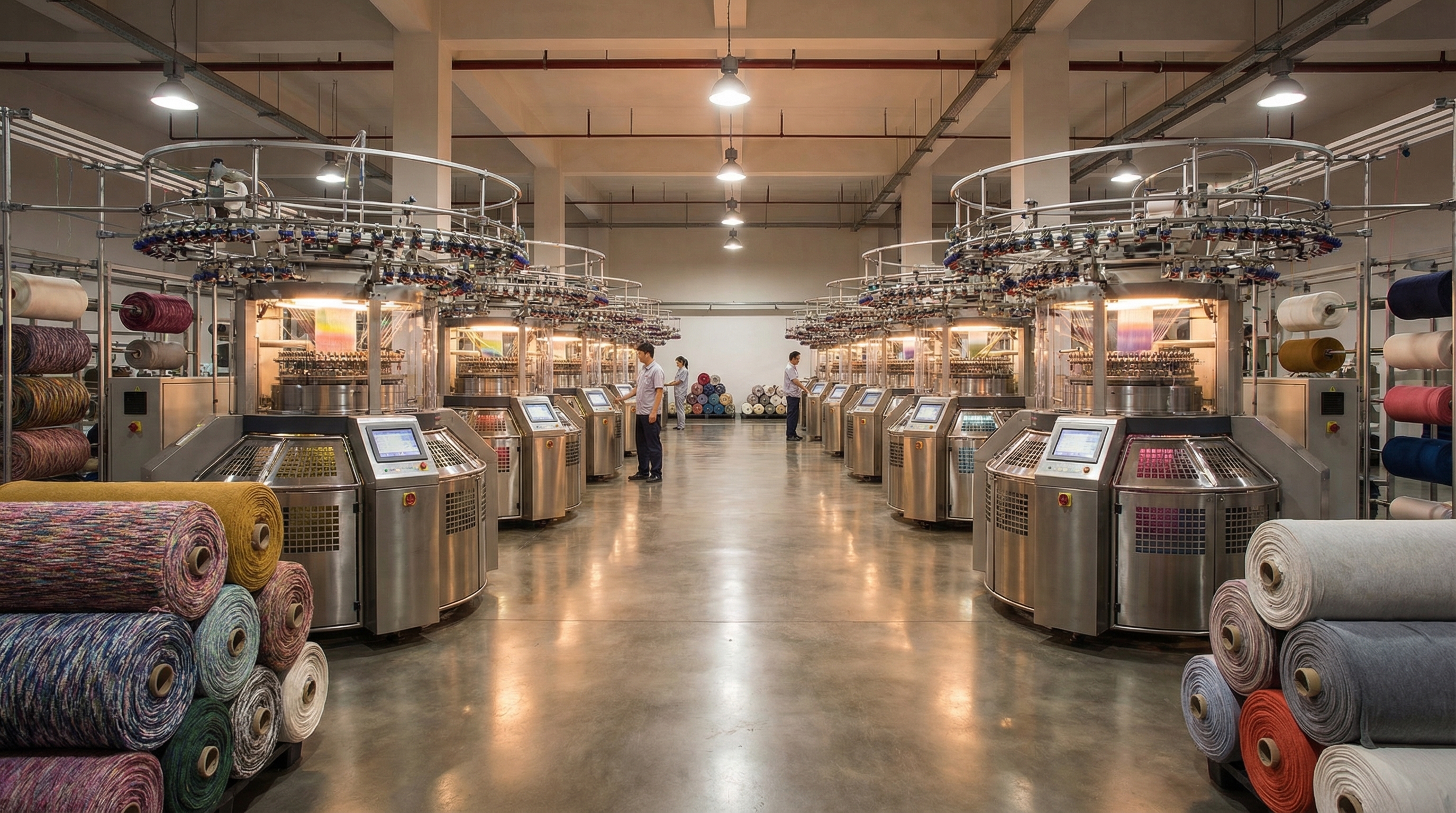
When people talk about Guangzhou sourcing, they often start with market size. But that is not the real reason the region remains useful for international buyers. What matters more is that fabric search, sample development, dyeing, trims, and export coordination can still move through one dense operating ecosystem. That density is a supply-chain advantage on its own.
Guangzhou works as a network, not just as a market
The strength of Guangzhou is not simply that buyers can see many fabrics. It is that fabric sellers, processors, makers, logistics partners, and export support are not isolated from one another. Information, samples, and decisions can move across a shorter operating radius.
That is very different from regions that offer only factories or only trading markets. Guangzhou works more like a compressed sourcing-and-development network. For brands with short calendars, many SKUs, and frequent revisions, that matters a lot.
Zhongda helps buyers discover options, the wider Pearl River Delta helps them execute
If Guangzhou is viewed as a system, Zhongda and the surrounding market area act as the front-end discovery engine. The nearby factory network in Foshan, Panyu, and the broader Pearl River Delta then turns those options into workable production paths.
Seen together, the cluster advantage becomes clearer:
| Supply-chain stage | What the Guangzhou cluster offers | Why it matters to buyers |
|---|---|---|
| Fabric search | Dense market coverage and broad construction range | Faster shortlisting |
| Sample development | Nearby processors and quicker revision loops | Shorter trial cycles |
| Dyeing and finishing | Mature knit-finishing support | Easier differentiation and re-sampling |
| Trims and packaging | Supporting resources close by | Lower coordination friction |
| Export delivery | Port access plus export service networks | Smoother handoff to global shipping |
So the edge is not one dramatic strength in one place. It is the low switching cost across the whole chain.
The biggest gain is usually speed of communication and correction
Buyers often capture cost and lead time in spreadsheets, but many real sourcing problems are about misunderstanding and correction speed. The hand is not right, the weight drifts, the shade changes, or the end use gets adjusted late. Those are normal project realities.
Guangzhou helps because many of those issues can be corrected without long-distance coordination across multiple provinces. Suppliers, dye houses, merchandisers, and logistics partners can align faster, which directly affects:
- How quickly a sample can be revised
- Whether a small issue grows into a bulk problem
- Whether there is still time to recover after a disruption
- How well the supply chain reacts when the customer changes direction
What looks like a factory issue on paper is often a network-response issue in practice.
What kinds of projects benefit most from Guangzhou
Guangzhou is not the answer for every order type, but it is especially effective for projects that involve:
- Broad sampling and fast option comparison
- Knit-heavy development with multiple construction changes
- Mid-sized volumes that require both flexibility and consistency
- Parallel coordination across fabric, finishing, packaging, and shipping
- A need to keep communication inside one operating region as much as possible
If the project is purely standardized and driven almost entirely by lowest cost, other models may work as well. But once the order requires adjustment, comparison, or iterative development, Guangzhou’s cluster structure becomes much more valuable.
Global delivery strength is more than proximity to a port
It is easy to reduce Guangzhou’s logistics value to geography, but the stronger advantage is operational continuity between production and export.
That includes:
- Faster transition from sample approval to production planning
- Better coordination of packaging, labeling, and shipping documents
- More room to react when sailing schedules shift
- Easier alignment between fabric-side and finished-garment-side information
That is one reason the region still performs well across Europe, Southeast Asia, and Middle East programs. It may not always be the cheapest point in the chain, but it is often better at keeping the chain connected.
Buyers should test whether the chain can close, not only whether one quote looks good
To evaluate Guangzhou properly, it is not enough to review one mill or one market supplier in isolation. The more useful question is whether the operating chain can close effectively around the project.
Practical checkpoints include:
- Can sourcing, re-sampling, and sample correction happen efficiently in the same regional loop?
- Are dyeing and finishing resources stable, or sourced ad hoc every time?
- Does the commercial team understand export documents and overseas communication?
- Can the supply chain re-sequence quickly if specifications change?
- Can problems found during development be traced back to the correct process stage?
If the answers are solid, Guangzhou’s structural value becomes real project value rather than general reputation.
The lasting value of Guangzhou is that it reduces fragmentation in complex programs
Global sourcing options continue to expand, and supply chains keep shifting across regions. Even so, Guangzhou still holds one advantage that is difficult to replicate quickly: it compresses high-frequency communication, rapid iteration, and multi-party coordination into a more workable operating geography.
For international buyers, that advantage shows up in very practical ways: faster sample rounds, lower correction cost, earlier problem discovery, and steadier execution. For any program that is not purely commodity buying, that remains highly relevant.