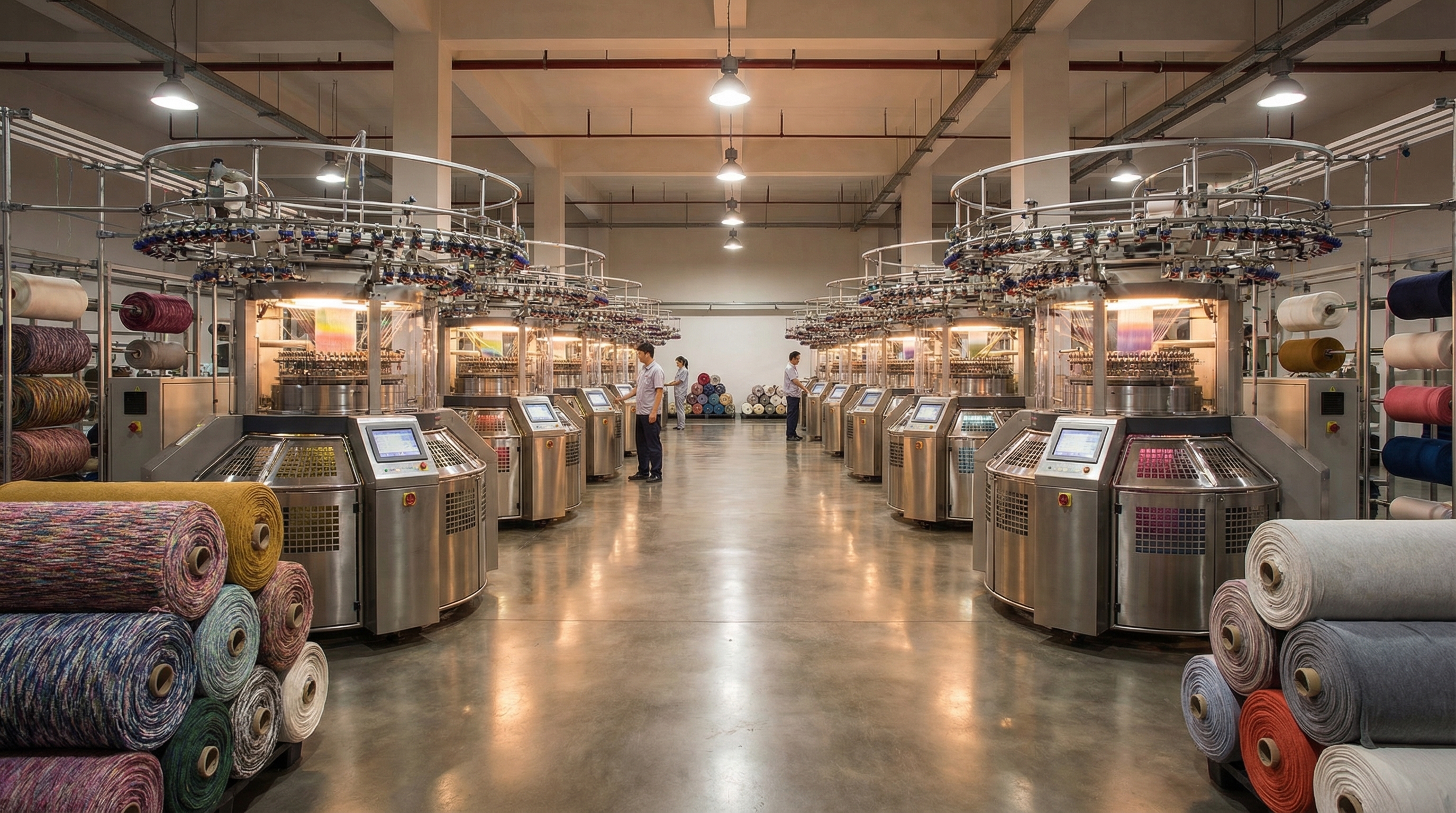
Global textile manufacturing has clearly spread into Southeast Asia, South Asia, and other regions. That shift is real. But another reality is just as important: many brands still return to China for critical development, more difficult fabrics, and high-frequency replenishment. The reason is not mystery or habit. It is supply-chain efficiency.
Capacity can move faster than coordination capability
Factories can be built, machines can be purchased, and labor-cost advantages can change. What is much harder to rebuild quickly is a complete operating network that connects yarn, knitting, dyeing, trims, development, and export support.
That is where China still holds an advantage. Many regions can support standardized bulk production. Fewer can support programs that involve repeated sampling, technical adjustments, stable coloration, or multi-step coordination under time pressure.
So manufacturing migration and supply-chain replacement are not the same thing. The first often happens. The second only happens in certain order types and certain categories.
China’s strongest asset today is often not lower cost, but faster closure of the loop
If sourcing decisions are judged only by labor cost, China will not always win. But if the buyer evaluates the full loop of search, development, revision, re-sampling, replenishment, and export readiness, China often still closes the loop faster.
That efficiency usually comes from three factors:
- Dense upstream and downstream support
- Shorter information chains
- More experience solving complex exceptions
For buyers, that translates into very practical differences:
| Situation | Lower-coordination chain | Higher-coordination chain |
|---|---|---|
| Sample revision | Many handoffs and a longer cycle | Faster access to the actual process point |
| Repeat color | Treated like a new project each time | Built on prior control and experience |
| Small replenishment | Low supplier interest and slower action | Easier to fit into an existing system |
| Multi-category work | Managed in fragments | Easier to align under one operating window |
This is why a higher nominal unit price can still produce lower overall project loss.
Southeast Asia can take more production, while China still leads many development stages
This is not an argument against regional diversification. It is a reminder that different regions are often better suited to different roles within the same supply chain.
Many brands now use a more realistic split:
- China for front-end development, more complex fabrics, and difficult execution
- Southeast Asia for selected garment manufacturing and more cost-sensitive bulk
- Both regions supporting the same brand calendar in different ways
That structure works because development and scale production do not always need to happen in the same place. In knit programs especially, fabric-side iteration speed still shapes overall performance.
The true efficiency moat shows up when something goes wrong
Supply chains are easiest to overestimate when everything goes smoothly. Many regions can produce acceptable results in stable conditions. The real difference appears when the order changes, the shade is off, the logistics window shifts, or the customer suddenly adds volume.
China still holds an advantage partly because recovery is often easier there:
- Alternate yarn or process routes are easier to find
- Dyeing and finishing windows can be re-sequenced faster
- Commercial, technical, and logistics teams can realign more quickly
- Urgent replenishment is easier to insert into an existing system
These abilities rarely appear as separate line items in a quotation, but they strongly influence whether a program stays under control.
Buyers do not need an all-or-nothing choice
For brands redesigning their global production map, the better move is often not “leave China” or “stay fully in China.” A more useful model is to assign regions by order complexity.
One practical split looks like this:
| Order type | Better regional fit |
|---|---|
| Complex fabric development | China |
| Frequent small-batch replenishment | China or nearby mature clusters |
| Cost-driven large garment runs | Southeast Asia or South Asia |
| New collections with multiple revisions | Start in China, then evaluate transfer |
This lets each region do what it handles best instead of forcing one location to satisfy every objective.
In knit sourcing, efficiency is much more than the quoted meter price
Many real costs in knit programs do not appear directly in the fabric quote. Repeated sampling, failed shade approvals, construction rework, delayed delivery, and export-document corrections all consume margin.
China’s remaining moat is that it often reduces these hidden losses. As long as buyers are sourcing products with iteration, quality expectations, and calendar pressure, that value does not disappear simply because capacity is spreading elsewhere.
China’s role is changing, but its value has not disappeared
China is no longer only selling production capacity. In many categories, it is selling a more mature development-and-execution system. That means it may not always be the cheapest option, but it often remains one of the steadiest options for important programs.
If you are rebalancing your global supply chain, the useful question is not only where nominal costs are lower. It is where your team can make fewer mistakes, recover faster, and keep delivery performance more reliable. That answer still leaves China in a meaningful position for many buyers.